Punjab Govt Approves New Electricity Duty on Large Power Users – 4 Paisa per Unit Tax Introduced 2025
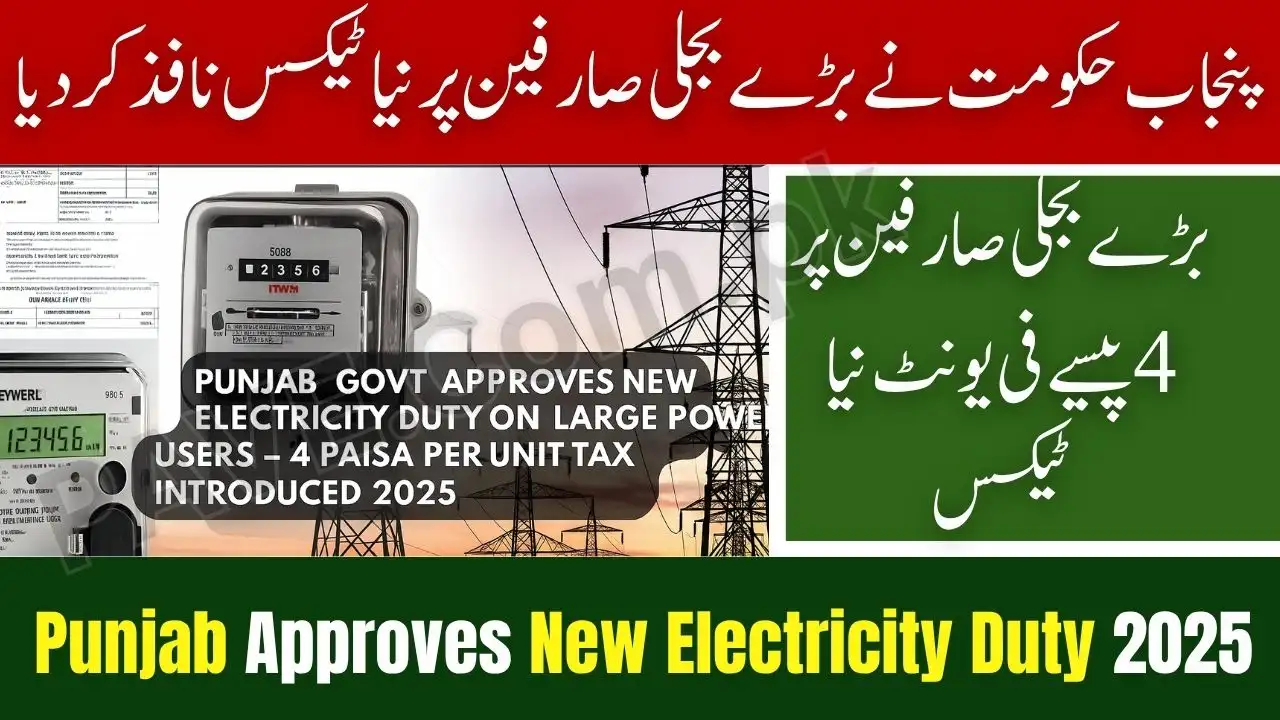
The Government of Punjab has approved a new electricity duty for industrial and commercial consumers under the Punjab Finance (Amendment) Bill 2025, marking a key reform in the province’s energy taxation system.
The newly introduced Punjab New Electricity Duty 2025 aims to bring fairness to the tax structure by ensuring that high-power users contribute proportionally, while domestic consumers remain fully exempt from any additional charges.
Overview of Punjab Electricity Duty 2025
According to the newly passed amendment, industrial and commercial consumers using more than 500 kVA of electricity will now pay an additional 4 paisa per unit as electricity duty. The Punjab Assembly passed this bill without referring it to any committee, emphasizing the government’s urgency to expand the province’s revenue base and regulate high-consumption energy sectors.
| Consumer Category | Electricity Duty (per unit) | Status |
|---|---|---|
| Domestic Users | 0 paisa | Fully Exempt |
| Industrial / Commercial Users up to 500 kVA | 0 paisa | Exempt |
| Industrial / Commercial Users above 500 kVA | 4 paisa | Applicable |
| Private Generators above 500 kVA | 4 paisa | Applicable |
Officials confirmed that Distribution Companies (DISCOs) will automatically collect this duty from grid users, while Electric Inspectors will handle collections from private generators and large institutions running heavy power systems.
Check Also: Voter ID Registration 2025 – Step-by-Step Online Process in Pakistan

Purpose of Introducing the New Duty
The Punjab Electricity Duty 2025 has been designed to increase provincial revenue without burdening ordinary citizens. Government sources stated that around 85 percent of Punjab’s electricity consumption comes from industrial and commercial sectors. Therefore, applying a minor duty to these large users ensures fairness while maintaining affordability for households and small businesses.
Officials said the measure will help Punjab generate additional revenue in billions, enabling the government to reinvest in energy infrastructure upgrades, renewable power expansion, and industrial facilitation programs. It also supports the goal of reducing the province’s reliance on federal transfers by creating new internal revenue streams.

Key Features of Punjab Finance (Amendment) Bill 2025
The Punjab Finance (Amendment) Bill 2025 modifies the Punjab Finance Act 1964 to incorporate new taxation rules for high-power electricity users. Its main highlights include:
- Introduction of a 4 paisa per unit duty for industrial and commercial users exceeding 500 kVA.
- Inclusion of private generators over 500 kVA in the tax network.
- Zero exemption for institutions misreporting their consumption.
- Collection through DISCOs and Electric Inspectors for transparency.
- Governor’s approval pending, after which enforcement will begin.
Finance officials described the amendment as a step toward a progressive taxation model where bigger consumers contribute more proportionally, helping Punjab achieve sustainable fiscal growth.

Impact on Industrial and Commercial Users
For industries and large commercial setups, the new duty means a slight increase in operational costs. Though 4 paisa per unit appears small, large consumers using millions of units monthly will experience a noticeable financial effect.
Energy analysts note that this policy could encourage industries to adopt energy-efficient systems, invest in solar and renewable sources, and monitor power use more closely. Sectors such as textile, manufacturing, cement, steel, data centers, and malls are among those likely to fall under this category.
Economists, however, believe the cost impact will remain marginal since the duty accounts for less than 0.5 percent of the total power tariff. They argue that this minimal rate balances fiscal responsibility and industrial growth.

Exemption for Domestic and Small Businesses
The Punjab government has reassured citizens that domestic electricity users will remain completely exempt from this new levy. Likewise, small and medium businesses consuming less than 500 kVA are protected.
The government clarified that the duty will not apply retroactively; it will only be enforced after the Governor’s formal approval and publication in the provincial gazette. This exemption structure demonstrates Punjab’s commitment to protect low-income consumers while generating funds from sectors that can afford the additional cost.
Collection and Enforcement System
The government has devised a two-tier system for collecting the new duty:
- For Grid Consumers: Power distribution companies such as LESCO, MEPCO, FESCO, and GEPCO will incorporate the new duty directly into monthly electricity bills.
- For Private Generators: Institutions running generators or alternate power setups exceeding 500 kVA will be monitored by Electric Inspectors, who will calculate duty based on meter readings and consumption data.
This structure ensures full coverage of both grid and non-grid electricity usage, closing loopholes and preventing tax evasion.
Reaction from Business Community
Reactions among industrial associations have been mixed. Some business leaders have expressed concerns that this new duty might slightly raise production costs, particularly in energy-intensive industries. However, others have acknowledged that the modest rate is a reasonable trade-off to support the province’s fiscal health.
The Lahore Chamber of Commerce and Industry (LCCI) urged the government to ensure that funds collected through this duty are transparently reinvested in industrial power infrastructure. Energy experts further advised that the provincial government should pair this duty with energy-efficiency incentives, ensuring businesses can recover the cost through modern technologies and reduced wastage.
Link to Punjab’s Fiscal Policy
The Punjab Electricity Duty 2025 fits within Chief Minister Maryam Nawaz’s broader financial vision emphasizing self-reliance, improved tax collection, and sustainable energy management. The government aims to diversify provincial income sources while maintaining public protection and economic growth.
Similar fiscal initiatives — such as the Punjab Infrastructure Cess, Urban Property Tax, and Vehicle Registration Reforms — have already boosted local revenue. The new electricity duty adds to these ongoing reforms and contributes to the government’s strategy of gradually strengthening provincial autonomy.
Revenue Projections and Utilization
Preliminary reports from the Punjab Finance Department suggest the new duty could yield more than Rs. 5 billion annually. The generated revenue will be directed toward:
- Expanding renewable energy projects under the Punjab Solar Transformation Plan 2025.
- Modernizing industrial grids and replacing outdated distribution lines.
- Supporting small industrial estates with energy-efficiency programs.
- Improving electricity access in under-served rural communities.
By strategically reinvesting this revenue, Punjab hopes to ensure long-term power reliability and promote clean-energy adoption across industries.
Official Government Statement
A spokesperson for the Punjab Finance Ministry stated:
“The Punjab Electricity Duty 2025 is designed to ensure fairness. Those using massive amounts of power must contribute more to strengthen the province’s fiscal stability. Domestic consumers will not pay a single paisa.”
The spokesperson added that all procedures would be digitally monitored to guarantee transparency and that educational, health, and charitable institutions operating below 500 kVA will remain fully exempt.
Implementation Timeline
Once the Governor of Punjab gives assent, implementation will start within 30 days. Distribution companies have already begun updating their billing systems to reflect the new rates. The Energy Department will also issue a notification outlining duty calculation methods, dispute procedures, and appeal rights for consumers.
Public Awareness Campaign
To ensure smooth rollout, the Punjab Finance Department plans to launch an awareness campaign through newspapers, TV, and digital media. The public will be able to access detailed information, FAQs, and duty calculators on the official portal finance.punjab.gov.pk.
For complaints or billing errors, consumers can contact their nearest Electric Inspector Office or call the Punjab Helpline 0800-99000 for assistance.
Frequently Asked Questions (FAQs) about Punjab Govt New Electricity Duty:
1. What is the Punjab Electricity Duty 2025?
It is a 4 paisa per unit charge on industrial and commercial electricity users consuming more than 500 kVA, introduced under the Punjab Finance (Amendment) Bill 2025.
2. Who will pay this duty?
Large industrial and commercial consumers connected to the national grid or private generators exceeding 500 kVA.
3. Are domestic users affected?
No, domestic and small consumers remain fully exempt.
4. When will it come into effect?
After the Governor’s formal approval and gazette notification, expected within one month.
5. How will it be collected?
Through DISCOs for grid consumers and Electric Inspectors for generator users.
6. Why was this introduced?
To expand the tax base, fund infrastructure improvements, and reduce reliance on federal transfers.
7. What happens if a company misreports its consumption?
It may face penalties or back-billing under the Punjab Finance Act 1964.
8. How will funds be utilized?
For renewable energy expansion, industrial modernization, and provincial electrification.
Check Also: Breaking News: UHS Replaces Theory Exams With New Assessment Method
Conclusion -Punjab Govt Approves New Electricity Duty on Large Power Users
The approval of the Punjab Electricity Duty 2025 marks a milestone in Punjab’s journey toward fiscal and energy reform. By targeting only heavy-power users and safeguarding domestic consumers, the government aims to achieve a fair, transparent, and sustainable energy taxation model.
This duty will strengthen provincial finances, modernize electricity infrastructure, and help promote energy efficiency and renewable transformation across Punjab — ensuring balanced growth for industries and citizens alike.