
Govt Vehicles to Get E-Challans for Traffic Violations in Sindh
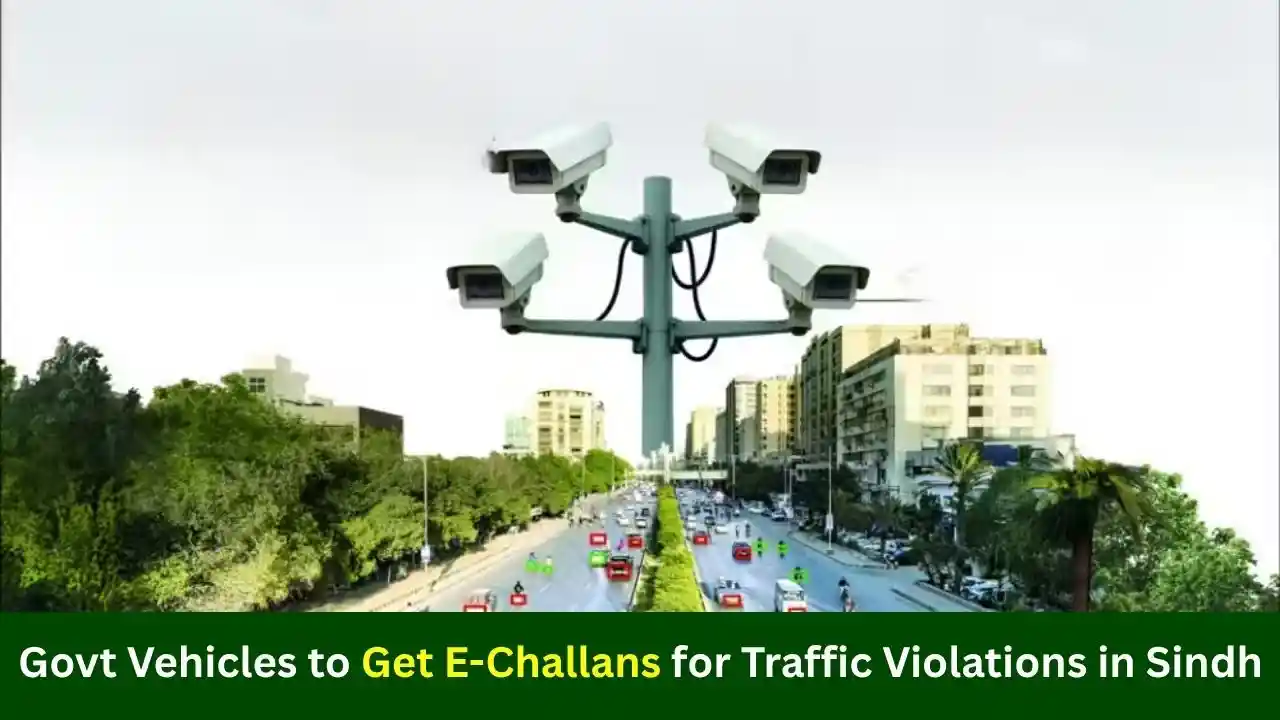
The Sindh government has officially allowed the Karachi traffic authorities to issue e-challans (electronic fines) to government vehicles that violate traffic laws.
This marks a major shift in accountability as official vehicles, which were often seen breaking rules with immunity, will now face the same penalties as private citizens.
The written directive, issued by the Services, General Administration, and Coordination Department (S&GAD), bears the signature of Section Officer CT Aqeel Hussain Mako.
The notification clearly states that any government-owned vehicle found violating traffic rules will be issued an e-challan, and the concerned officer or employee will be required to pay the fine personally.
The directive is enforceable under Section 116A of the Karachi Traffic Ordinance, 1956.
Official Notification Details
According to the S&GAD circular, the order has been forwarded to major provincial offices and institutions, including:
- Senior Member, Board of Revenue
- Chairman, Anti-Corruption Establishment
- Chairman, Planning & Development Department
- Chairman, Chief Minister’s Inspection Team
- Chairman, Sindh Public Service Commission
- Chairman, Sindh Service Tribunal
Copies of the order have also been dispatched to all divisional commissioners and departmental secretaries across Sindh.
Officials said the directive applies to all types of government-owned vehicles, whether used by civil departments, public institutions, or law enforcement agencies (when off-duty).

Traffic Violations Covered Under the E-Challan System
The Karachi Traffic Police confirmed that the following violations will now trigger automatic e-challans for both private and government vehicles:
| Violation | Penalty Type |
|---|---|
| Driving without a seatbelt | Fine & digital notice |
| Using mobile phone while driving | Fine & demerit points |
| Running red light | Fine & license flag |
| Using tinted windows | Fine & vehicle inspection |
| Wrong-lane or one-way driving | Fine & points deduction |
| Number plate tampering | Fine & confiscation warning |
| Over-speeding | Fine via camera system |
Officials added that the Safe City digital cameras installed across Karachi automatically capture violations, generate challans, and send notifications to registered vehicle owners via SMS and courier.
Read Also: Breaking News: Punjab Reissues Revised 9th Grade Smart Syllabus 2025 – All Errors Removed by PECTA

Accountability for Government Employees
One of the major points in the order is personal accountability.
Unlike the past, where departments often ignored fines or transferred responsibility, this new policy ensures that the specific officer or driver using the vehicle must pay the e-challan out of their own pocket.
If payment is delayed or ignored, the fine may be deducted from salary or reported to the Anti-Corruption Department for disciplinary action.
An official from the S&GAD said,
“This move will end the culture of impunity. Every driver—public or private—will now follow the law. No one is above traffic regulations.”

Digital Enforcement in Karachi
The e-challan system in Karachi, part of the Sindh Safe City initiative, uses AI-based surveillance cameras placed at intersections, flyovers, and major roads like Shahrah-e-Faisal, University Road, and M.A. Jinnah Road.
These cameras are linked with the Excise and Taxation Department’s registration database.
When a violation is detected:
- The camera captures a photo and video of the incident.
- The system automatically identifies the vehicle registration.
- A digital challan is generated and sent via SMS.
- A printed challan is also mailed to the registered address.
Payments can be made online, through designated banks, or via mobile wallet services like JazzCash and Easypaisa.

Why the Step Was Necessary
Karachi has seen a surge in reckless driving, signal violations, and road accidents in recent years. Many citizens have often complained that government vehicles, especially those with green number plates, frequently break signals or park in no-parking zones with no consequences.
This new decision aims to restore equality before the law and send a strong message that traffic rules apply to everyone, regardless of their position or department.
According to Karachi Traffic Police data, over 6,000 violations are recorded daily, and the new inclusion of official vehicles will significantly boost compliance.
Legal Basis: Section 116A of Traffic Ordinance 1956
Under Section 116A of the Karachi Traffic Ordinance 1956, any vehicle—private or government—can be fined for a traffic violation.
The law gives traffic authorities the right to:
- Impose penalties for all offenses under the ordinance.
- Hold the vehicle user responsible for payment.
- Suspend registration in case of non-payment.
This clause forms the legal foundation for including official vehicles under the e-challan framework.
Departments Bound to Cooperate
The Sindh government has directed all department heads, divisional commissioners, and district officers to ensure full cooperation with traffic police.
Every department must maintain a record of challans issued against their vehicles and ensure timely payment.
Officials failing to comply could face administrative proceedings under the Government Servants (Efficiency and Discipline) Rules.
Public Reaction
The decision has received widespread appreciation on social media.
Citizens praised the government for finally taking action to ensure “no VIP treatment on the roads.”
Many users highlighted that official vehicles should set an example instead of breaking traffic rules.
Hashtags such as #EChallanKarachi and #OneLawForAll trended across X (formerly Twitter) and Facebook soon after the announcement.
Read Also: Gold Price in Pakistan Today 9 November 2025 – Latest 24K, 22K Prices in All Major Cities
Expert Opinions
Traffic law expert Barrister Adeel Ansari said,
“This is a landmark step toward accountability and road safety. Government vehicles often misuse privilege. Extending e-challans to them promotes fairness and strengthens rule of law.”
Urban policy analyst Dr. Seema Ahsan added,
“Technology-driven governance works only when it applies equally to all. This initiative will improve compliance and reduce accidents.”
Impact on Road Safety and Public Perception
Experts believe this step will bring three major benefits:
- Improved Compliance:
Drivers of official vehicles will now think twice before breaking traffic rules. - Increased Revenue:
More fines collected through e-challans will contribute to road-safety programs. - Public Trust:
Equal application of law enhances public faith in the justice system and police integrity.
Implementation Challenges
Despite the positive reception, officials admit there may be early challenges, such as:
- Identifying the actual driver behind a government vehicle at the time of violation.
- Ensuring prompt challan payment by departments.
- Addressing possible misuse of “diplomatic” or “emergency” exemptions.
Authorities are working on linking vehicle ID cards and driver CNICs to make enforcement more precise.
E-Challan Payment Procedure
| Method | How to Pay |
|---|---|
| Online (Bank) | Visit Sindh Police e-challan portal and pay using bank app. |
| Mobile Wallets | Pay via Easypaisa or JazzCash under “Sindh Traffic Challan” option. |
| In Person | Pay at designated traffic police offices or branches of National Bank of Pakistan. |
A receipt will be automatically updated in the system, confirming payment and removing pending fines.
Expansion to Other Cities
Officials hinted that after Karachi’s successful implementation, the same e-challan policy for government vehicles will be introduced in Hyderabad, Sukkur, and Larkana.
The Sindh Police’s central IT team is currently upgrading the system for province-wide integration.
Conclusion About Govt Vehicles E-Challan Sindh 2025:
The Sindh government’s decision to enforce e-challans for official vehicles represents a milestone in equal law enforcement and digital governance.
By ensuring that public servants obey the same traffic rules as citizens, the government is taking a meaningful step toward road discipline, transparency, and fairness.
With continued enforcement and technology integration, Karachi could become a model city for smart traffic management across Pakistan.
FAQs About Govt Vehicles E-Challan Sindh
1. Can government vehicles be fined in Karachi now?
Yes. The Sindh government has made all government vehicles liable for e-challans under Section 116A.
2. Who pays the fine for an official vehicle?
The officer or driver responsible for the violation must personally pay the fine.
3. What happens if the fine is not paid?
Failure to pay can lead to disciplinary action or deduction from salary.
4. Are police and emergency vehicles included?
Yes, but only when they are used for non-emergency or personal purposes.
5. Can I check a government vehicle’s challan online?
Yes, the e-challan portal allows checking challan details for all registered vehicles.