Govt Vehicles to Receive E-Challans for Traffic Violations Under New Policy
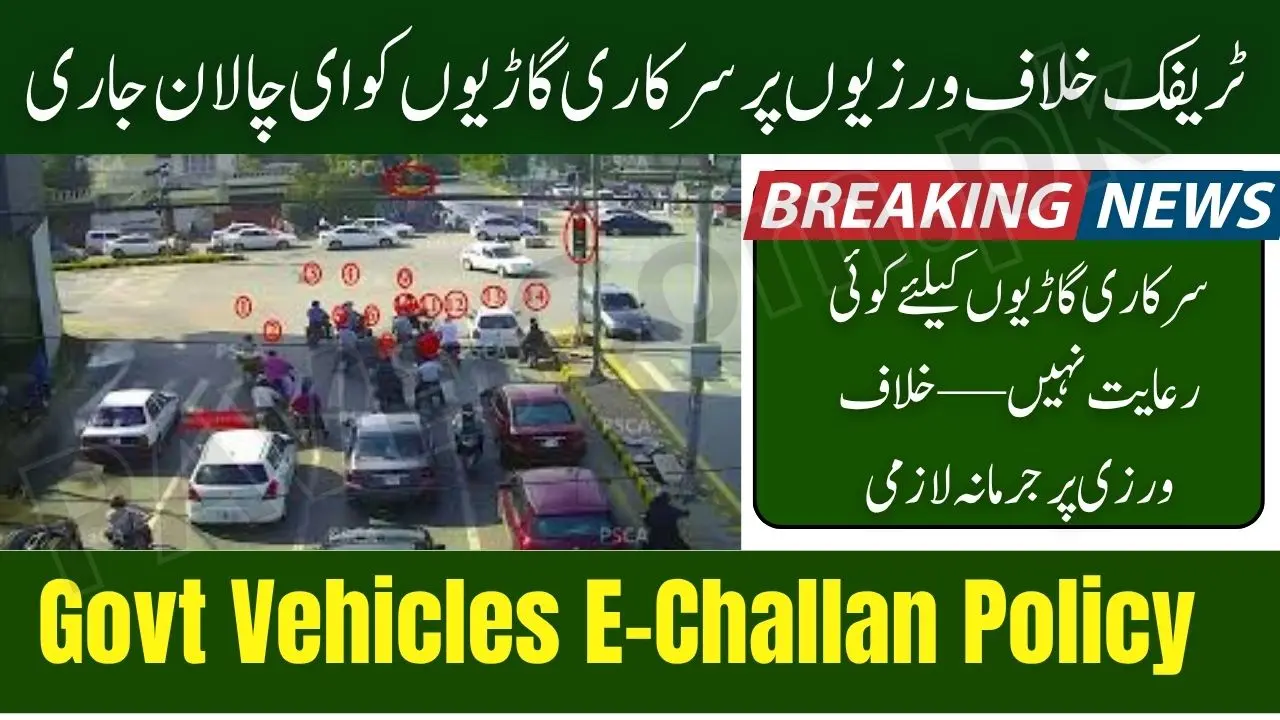
The Sindh government has taken a bold administrative step by officially approving the issuance of e-challans to government vehicles found violating traffic laws in Karachi. This decision marks a major shift in how official cars—previously seen enjoying a level of immunity—will now be held accountable like any ordinary motorist. The Govt Vehicles E-Challan Policy aims to strengthen road discipline, reduce misuse of government resources, and enhance transparency in public departments.
This policy came into effect through a formal written directive issued by the Services, General Administration and Coordination Department (SGA&CD), signed by Section Officer CT Aqeel Hussain Mako. With this new system, if any official vehicle breaks a traffic rule—whether it’s speeding, lane violation, signal jumping, or driving without a seatbelt—an automated e-challan will be sent directly to the concerned government office, and the responsible officer will be required to pay the fine from their personal pocket.
The new move is being praised for bringing equality in law enforcement, promoting responsible driving, and discouraging misuse of government number plates for avoiding penalties. It also aligns Karachi’s traffic enforcement system with modern smart-city practices already implemented in advanced metropolitan cities.
Why the New Govt Vehicles E-Challan Policy Was Needed
For years, one of the biggest challenges faced by traffic authorities in Karachi was the frequent violation of road rules by official cars. Due to the absence of accountability mechanisms, many such vehicles—bearing government number plates—were seen breaking traffic laws without consequences. This behaviour not only disrupted traffic discipline but also encouraged the misconception that official vehicles were above the law.
The introduction of the Govt Vehicles E-Challan Policy directly tackles these issues. By ensuring that everyone, including government employees, is treated equally under traffic regulations, the Sindh government hopes to promote responsible driving habits and reduce traffic chaos in the city.
Additionally, the decision supports a transparent governance model where public resources must be used responsibly, and misuse of authority is discouraged.

What the Official Notification Says
According to the SGA&CD notification, traffic police and the Karachi Safe City surveillance system have been given full authority to impose e-challans on official vehicles whenever a violation is recorded. The notification states:
- Any government vehicle caught violating traffic rules will be issued an e-challan automatically.
- The fine must be paid personally by the officer or employee using the vehicle at the time of violation.
- No government department will bear the penalty amount from official funds.
- The enforcement will follow Section 116A of the Motor Vehicles Ordinance 1956.
This makes it clear that accountability has finally reached government vehicles, removing any loopholes that were previously misused.

Government Departments Notified About the Policy
To ensure smooth implementation, the notification has been sent to all major provincial bodies, including:
- Senior Member Board of Revenue
- Chairman Anti-Corruption Establishment
- Chairman Planning & Development
- Chairman Sindh Public Service Commission
- Chairman Chief Minister Inspection Team
- Chairman Sindh Service Tribunal
- All departmental secretaries
- All divisional commissioners
By involving these top administrative heads, the policy ensures strict compliance across the provincial machinery.

Traffic Violations That Will Lead to E-Challans
The Safe City and traffic enforcement system will issue e-challans for several violations, including:
- Signal jumping
- Speeding
- Wrong lane driving
- Driving without seatbelt
- Use of mobile phone while driving
- Riding or driving without a helmet (for motorcycles)
- Unauthorized number plate modifications
- Dangerous driving or zig-zag movement
These are the same categories for which private vehicles are already penalized.

How the E-Challan System Works for Government Vehicles
The mechanism for e-challans for government vehicles will be similar to that for private cars, with added administrative tracking.
1. Violation Captured Through Cameras
High-definition surveillance cameras installed across Karachi’s major roads, intersections, and signal points automatically detect violations by capturing vehicle number plates.
2. Number Plate Verification
The Safe City system identifies whether the vehicle belongs to a government department by cross-matching with official databases.
3. E-Challan Generated
Once verified, the system generates an e-challan containing:
- Type of violation
- Time and date
- Camera location
- Fine amount
- Evidence image
4. Delivery of E-Challan
The challan is sent electronically to the concerned government department, placing responsibility directly on the individual using the vehicle at the time of the violation.
5. Personal Liability for Fine Payment
The policy clearly states that the officer responsible must pay the fine personally. No government funds can be used for the payment of fines.
This is a major reform in accountability and traffic discipline.
Expected Benefits of the Govt Vehicles E-Challan Policy
The Sindh government expects several key improvements as a result of the policy.
1. Better Traffic Compliance
Government drivers will now follow traffic rules more responsibly, reducing violations and improving road safety.
2. Reduced Misuse of Government Vehicles
Previously, official number plates were often exploited for personal errands and to bypass traffic laws. The new system discourages such behaviour.
3. Enhanced Transparency
One of the aims of modern governance is transparency. The policy ensures that official vehicles are monitored and regulated through digital systems.
4. Improved Driver Behaviour
Knowing that every violation will result in an e-challan, officials and drivers will adopt safer driving habits.
5. Efficient Law Enforcement
Traffic police no longer need to physically stop or question government vehicles. Automated monitoring reduces human error and ensures equal treatment.
Public Reaction to the New Policy
The public response across Karachi has been largely positive. Many citizens view the decision as a step toward equality and fairness in traffic enforcement.
Social media users praised the move, stating that official cars violating rules without consequence was a long-standing issue. Some suggested further steps such as:
- Publishing monthly violation reports of government vehicles
- Training government drivers in safe driving
- Ensuring official drivers have valid and updated licences
Others urged the Safe City system to ensure that violators—whether public or private—have no room for escaping fines.
Challenges in Implementation
Although the policy is strong on paper, the government may face a few practical challenges:
1. Identification of the Responsible Officer
In departments with shared vehicles, determining who was driving at the time of violation may be difficult. However, departments can maintain logbooks to solve this issue.
2. Ensuring Timely Fine Payments
Strict administrative follow-up will be required to make sure violators pay fines personally and promptly.
3. Addressing Fake or Improper Number Plates
Some official vehicles use faded, damaged, or unclear plates, making automatic recognition difficult. Updating number plates may be necessary.
4. Internal Resistance
Some officers may initially resist the new accountability mechanism, but strict administrative instructions will resolve this.
Despite these challenges, experts believe that the benefits far outweigh the hurdles.
How This Policy Will Transform Karachi’s Traffic System
The Govt Vehicles E-Challan Policy is not just a rule—it represents a major cultural shift in how public servants interact with the traffic system. No longer will government plates guarantee immunity. Instead, the policy reinforces the principle that “No one is above the law.”
Over time, this shift is expected to:
- Reduce traffic violations
- Improve discipline on major roads
- Minimize misuse of government transport
- Build public trust in enforcement agencies
- Upgrade Karachi to a true smart-city traffic model
The move also aligns with broader reforms aimed at digitizing governance, improving public service delivery, and enhancing accountability.
Conclusion – Govt Vehicles E-Challan Policy
The Sindh government’s decision to implement the Govt Vehicles E-Challan Policy is a landmark step in traffic enforcement and public accountability. By ensuring that official vehicles are penalized just like private ones, the government is promoting equality, discipline, and transparency. As the Safe City system expands and enforcement becomes more automated, Karachi’s traffic landscape is set to improve significantly. This policy proves that good governance begins on the road—where rules must apply to everyone without exception.