Court Bans Use of Government Vehicles in Political Rallies Across KP
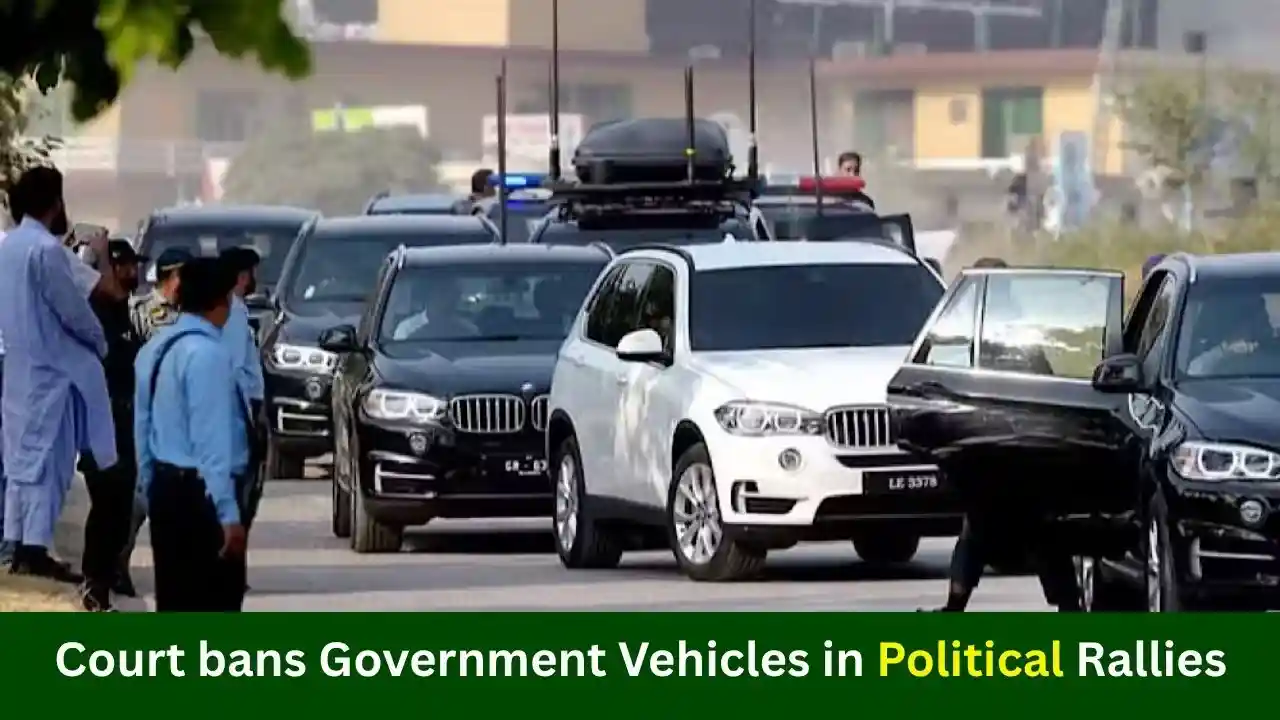
In a significant development aimed at promoting transparency and protecting public resources, the Peshawar High Court (PHC) has officially banned the use of government vehicles and employees in political rallies, protests, long marches, or any other partisan events.
The ruling, issued by a two-member bench comprising Justice Sahibzada Asadullah and Justice Dr. Khurshid Iqbal, declared that any such involvement of state property or employees in political activities constitutes “misconduct” under existing service and accountability laws.
This verdict is being hailed as a major step toward reinforcing the neutrality of the public sector and preventing misuse of taxpayer-funded resources for political gains.
Petition Highlights Misuse of State Resources
The judgment came in response to a petition filed by Jawad Ali, who alleged that the Khyber Pakhtunkhwa (KP) government had been using official vehicles during various political demonstrations and protests.
Through his counsel, Advocate Intikhab Chamkani, the petitioner provided lists of government-owned vehicles allegedly used for partisan purposes, claiming that this amounted to a misappropriation of public funds.
The petition further stated that several provincial departments and attached offices were providing logistical support for rallies organized by political groups, effectively turning public resources into campaign tools.
Jawad Ali argued that such practices burden the provincial exchequer and violate the constitutional principle of neutrality required of all government servants.

Court Reviews Evidence and Arguments
During the hearing, Justice Asadullah examined the documents and lists submitted by the petitioner, which included vehicle registration numbers, driver rosters, and alleged movement logs from recent political events across KP.
The Assistant Advocate General, representing the provincial government, denied these claims, calling the data “inaccurate and misleading.” He maintained that the PTI-led administration had not officially sanctioned any vehicles or employees for political activities.
According to the government’s legal representative, any government officers or drivers found at political rallies were participating voluntarily and were not there under official orders.
However, the bench observed that even private or “off-duty” use of official vehicles for political purposes violates public service ethics and the rules governing the use of government assets.
Read Also: Sri Lanka Announces ODI and T20I Squads for Pakistan Tour 2025 – Charith Asalanka to Lead Both Teams

Judges Stress Accountability and Democratic Boundaries
Justice Asadullah, authoring the written order, made it clear that the judiciary expects public institutions to maintain strict impartiality in a democratic system. He emphasized that no taxpayer-funded resource should ever be used to promote or support any political agenda.
“In a functioning democracy, institutions must operate within their constitutional limits,” the order stated.
“Public property cannot become a tool of political influence — regardless of which party holds power.”
The court reiterated that government vehicles, employees, and resources are meant solely for public service. Their diversion for political causes constitutes a breach of trust and an abuse of power.
Misconduct Defined Under Service Laws
The PHC further noted that participation of civil servants or government drivers in political activities — whether by direct involvement or through the use of official assets — is legally defined as misconduct under multiple service regulations, including:
- Government Servants (Conduct) Rules, 1964
- Civil Servants Efficiency and Discipline Rules, 1973
- Accountability and Transparency Ordinance, 1999
Under these laws, employees found guilty can face penalties such as:
- Suspension or termination
- Departmental inquiry and fines
- Legal prosecution in severe cases
The court also emphasized that heads of departments and administrative officers will be held accountable if they fail to prevent such misuse within their jurisdiction.

Government’s Stance and Court’s Observation
The provincial government’s legal team insisted that the alleged use of vehicles was not an officially endorsed act and that the lists provided were outdated. However, the court observed that even isolated incidents of misuse must be treated seriously to prevent institutional erosion and favoritism.
The bench reminded the government that transparency and lawful behavior are not optional but fundamental obligations of a democratic state.
“Public funds and property are entrusted for service delivery — not political mobilization,” the order read.
“Every officer, regardless of rank, must uphold neutrality and discipline.”
Directive to Provincial Administration
In its final order, the PHC issued strict instructions to all administrative departments, commissioners, and deputy commissioners across Khyber Pakhtunkhwa to ensure that:
- No government vehicle or fuel is used in any political gathering, rally, or long march.
- Government employees remain strictly non-partisan in their official capacity.
- Departmental heads conduct regular audits of vehicle usage and fuel logs.
- Violation reports be submitted to the Chief Secretary’s office for disciplinary action.
Failure to comply, the court warned, would be treated as serious misconduct and could lead to administrative or criminal proceedings.
Read Also: E-Bike vs Petrol Bike: Cost Comparison for Students and Workers in 2025
Public Reaction and Political Response
The ruling quickly drew attention across political and civil society circles. Many praised the PHC for taking a firm stance against political misuse of public property, saying it sets a positive precedent for institutional accountability.
Civil society organizations, particularly those advocating for good governance, hailed the judgment as a model decision that should be replicated nationwide.
Some opposition figures also welcomed the order, arguing that political neutrality of civil servants is vital for maintaining public confidence in the state.
Historical Context: Similar Cases in Pakistan
This is not the first time a court has addressed the issue of state resource misuse.
- In 2013, the Election Commission of Pakistan (ECP) issued a similar directive barring use of government vehicles during election campaigns.
- In 2018, the Lahore High Court ordered departmental inquiries against Punjab officials who used official transport for political meetings.
- More recently, in 2022, the Sindh High Court reprimanded provincial departments for using taxpayer funds for partisan advertising.
The Peshawar High Court’s new ruling, however, goes a step further by defining such acts as misconduct under service laws, giving it stronger enforcement authority.
Why This Decision Matters
This judgment carries broader implications for governance and accountability in Pakistan. It reinforces three key principles:
- Public resources are sacred trust assets.
They belong to the citizens — not to political parties or individuals in power. - Civil servants must remain neutral.
Their loyalty is to the Constitution, not to changing governments. - Accountability ensures fairness.
Transparent administration builds public confidence and deters corruption.
By holding officials accountable, the court aims to create a culture of responsibility in the use of government property.
Possible Future Implications
Following this ruling, it is likely that:
- Other High Courts may issue similar orders in their jurisdictions.
- Provincial audit departments could launch checks on fuel consumption and vehicle records.
- Election monitoring bodies may adopt stricter verification of state asset usage during campaigns.
Experts say the PHC’s verdict will serve as a legal precedent for future cases concerning abuse of official resources, especially ahead of upcoming elections.
Expert Opinion
Legal experts believe this ruling strengthens Pakistan’s institutional independence. Advocate Mubashir Khan, a constitutional law analyst, stated:
“This decision sends a powerful message that civil service neutrality must be protected. The court has drawn a clear line — taxpayer money cannot be used for political mileage.”
He added that such steps are essential to restoring public trust in state institutions, particularly when political polarization is at its peak.
Conclusion About Court bans government vehicles in political rallies:
As the directive takes effect, administrative departments across KP will now have to ensure strict compliance. This decision is expected to set a powerful legal precedent for other provinces, helping Pakistan move one step closer to cleaner, fairer, and more accountable governance.
FAQs About the PHC’s Ban on Government Vehicle Misuse
1. What did the Peshawar High Court decide?
The PHC banned use of government vehicles and employees in any political rallies, marches, or campaigns across Khyber Pakhtunkhwa.
2. Who filed the petition?
The case was filed by Jawad Ali, a private citizen, through Advocate Intikhab Chamkani.
3. Which judges issued the ruling?
The two-judge bench included Justice Sahibzada Asadullah and Justice Dr. Khurshid Iqbal.
4. Why was the case filed?
The petitioner alleged misuse of official vehicles by the provincial government during political demonstrations.
5. What does the court mean by “misconduct”?
It means any unauthorized or political use of state property that violates service laws or misuses taxpayer funds.