
Annular Solar Eclipse on February 17: Exact Timing, Visibility and How to Watch Safely
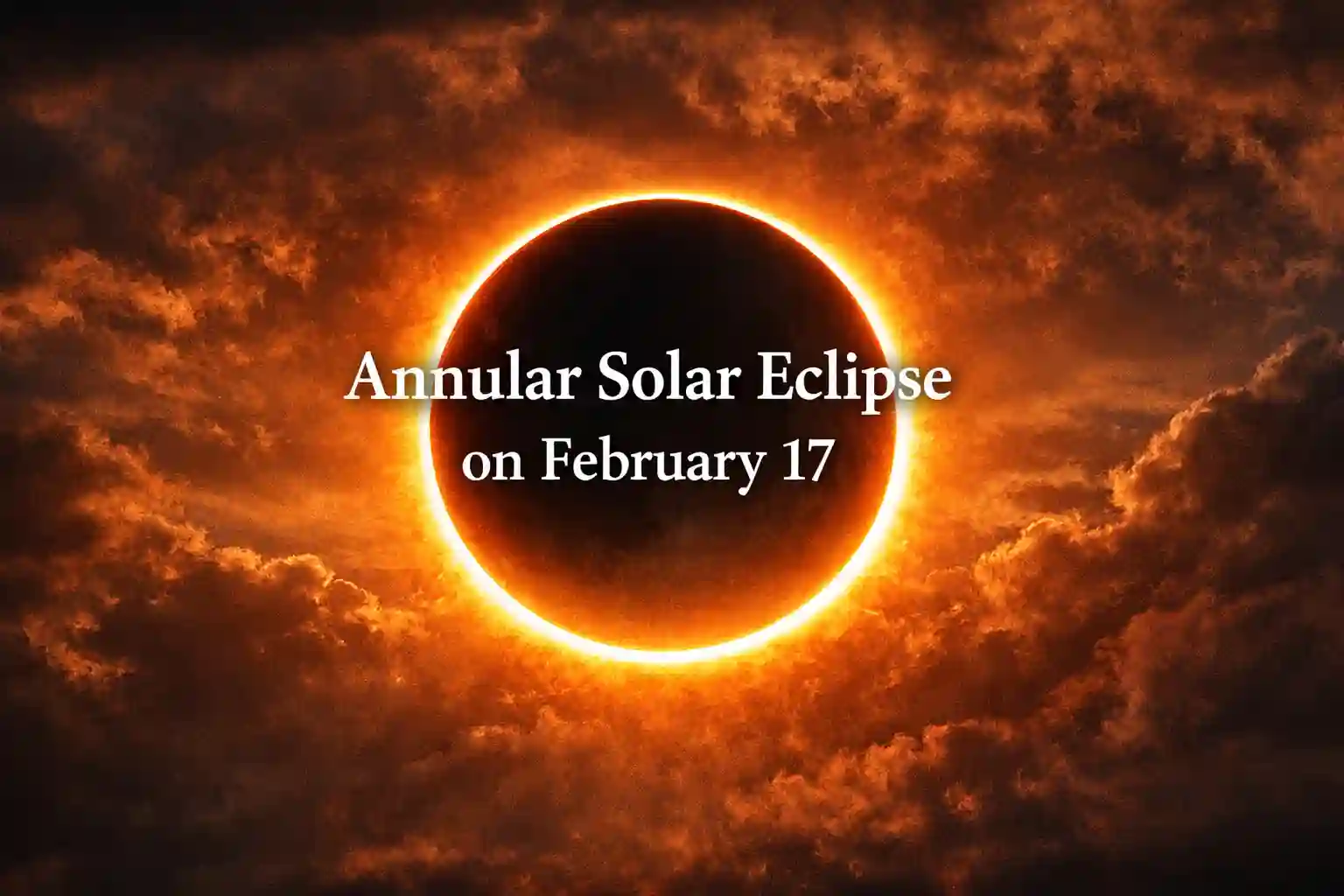
A major astronomical event is set to occur on February 17, 2026, when parts of the world will witness an annular solar eclipse, often called the Ring of Fire Eclipse. Solar eclipses always attract public interest, but annular eclipses are especially fascinating because they create a glowing ring in the sky.
Even though this eclipse will not be visible everywhere, many people across the world will follow it through online coverage and scientific broadcasts.
Here is a complete guide explaining what this eclipse is, where it will be visible, exact timing, and how you can watch it safely.
What Happens During an Annular Solar Eclipse?
A solar eclipse occurs when the Moon moves between the Earth and the Sun, temporarily blocking sunlight.
However, not all solar eclipses look the same. There are three main types:
- Total solar eclipse
- Partial solar eclipse
- Annular solar eclipse
During an annular eclipse, the Moon is positioned slightly farther away from Earth than usual. Because of this, the Moon appears smaller than the Sun in the sky.
When alignment happens, the Moon cannot fully block the Sun. Instead, the outer edge of the Sun remains visible as a bright ring around the Moon. This glowing circle creates the famous ring-of-fire effect.
Unlike a total eclipse, daylight never completely disappears during an annular eclipse.

Exact Timing of the February 17, 2026 Eclipse
The eclipse will last several hours as the Moon slowly moves across the Sun’s face. Astronomers divide the event into stages.
Expected timing in Universal Time (UTC) is:
- Partial eclipse begins: around 09:56 UTC
- Annular phase begins: around 11:42 UTC
- Maximum eclipse: around 12:12 UTC
- Annular phase ends: around 12:41 UTC
- Partial eclipse ends: around 14:27 UTC
The full ring-of-fire view will only last a few minutes for observers located exactly along the eclipse path. Outside this narrow region, people will only see a partial eclipse.
Timing may slightly vary depending on location.

Where Will the Eclipse Be Visible?
Visibility is limited for this eclipse, and not all continents will experience it.
Areas with Full Annular View
The complete ring-of-fire phase will mainly pass over:
- Parts of Antarctica
- Surrounding southern ocean regions
Because this region has a very small population, only scientists, researchers, and ships in the area will likely see the full annular effect directly.
Areas Seeing Partial Eclipse
Some regions may see the Sun partially covered, including:
- Southern parts of Africa
- Southern areas of South America
- Certain islands in the southern oceans
Areas Where Eclipse Will Not Be Visible
Countries across:
- Most of Asia
- Europe
- North America
- Pakistan and India
- Middle East regions
will not see the eclipse in the sky.
However, people worldwide can watch online livestreams organized by astronomy agencies and observatories.

Why Solar Eclipses Do Not Occur Every Month
Many people wonder why eclipses are rare if the Moon circles Earth every month.
The reason is the Moon’s orbit is slightly tilted compared to Earth’s orbit around the Sun. Most of the time, the Moon passes above or below the Sun from our viewpoint.
Only when Earth, Moon, and Sun align correctly does an eclipse occur.
This precise alignment makes solar eclipses special events.

How Scientists Use Solar Eclipses
Solar eclipses are not just beautiful sights; they also help scientists study the Sun and space environment.
During eclipses, scientists can:
- Study the Sun’s outer atmosphere
- Observe solar radiation changes
- Research Earth’s atmosphere reactions
- Monitor temperature and light variations
Even today, eclipses help scientists understand space weather and solar activity.
Safe Ways to Watch a Solar Eclipse
Watching a solar eclipse without protection can permanently damage eyesight. Even during an annular eclipse, sunlight remains strong and dangerous.
Safety should always come first.
Safe Viewing Methods
Use these safe methods:
- Wear certified solar eclipse glasses
- Use solar filters for telescopes and cameras
- Watch through pinhole projection
- Follow live broadcasts instead of direct viewing
Unsafe Methods to Avoid
Never use:
- Normal sunglasses
- Phone screens alone
- Tinted glass
- X-ray film or CDs
- Camera lenses without filters
Direct sunlight can harm eyes within seconds.
Watching the Eclipse Online
Since many regions cannot view this eclipse directly, online streaming will be popular.
Astronomy websites, observatories, and space organizations usually broadcast eclipses live with expert explanations. These streams allow viewers to enjoy the event safely from home.
Educational institutions also organize online programs to explain eclipse science.
Cultural Interest in Solar Eclipses
Solar eclipses have fascinated humans for thousands of years. Ancient civilizations often saw eclipses as powerful or mysterious events.
Today, science explains eclipses clearly, yet the excitement remains. Many people still gather to observe eclipses, making them shared global experiences.
Modern eclipses are now celebrated as educational and scientific opportunities rather than fearful events.
Future Solar Eclipses to Watch
Astronomy fans often plan travel around major eclipses. In coming years, several total and annular eclipses will occur across different regions.
Future eclipses may pass over more populated areas, allowing millions to see them directly.
Following eclipse schedules helps enthusiasts prepare early.
Conclusion – Annular Solar Eclipse on February 17
The Annular Solar Eclipse on February 17, 2026, will be a rare celestial event producing a ring-of-fire effect in limited parts of the southern hemisphere.
Although many countries will not see it directly, modern technology allows people everywhere to follow the event online. The eclipse also offers an opportunity to learn about astronomy and understand how celestial movements affect our planet.
Anyone interested in space and science should mark the date and watch this spectacular event safely through trusted broadcasts or proper viewing equipment.
Solar eclipses remind us how perfectly our solar system works and how much there still is to explore in the universe.