
ICC Announces Big Change in Test Cricket Law – Effective from 4th February 2026
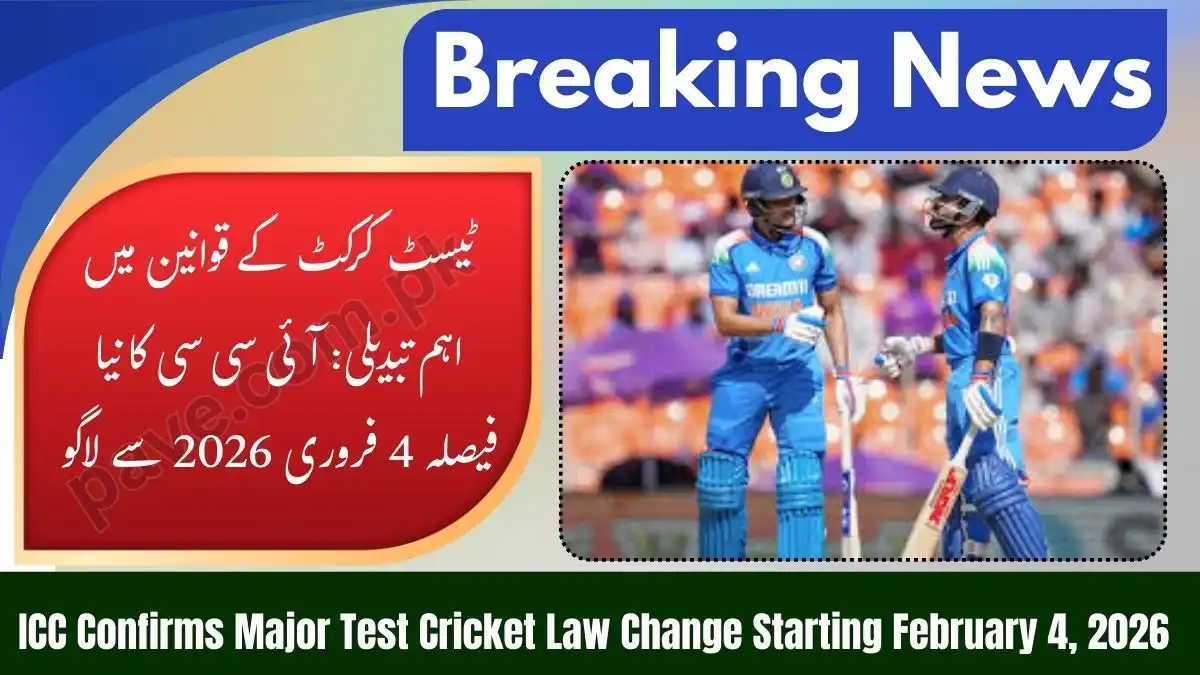
On Tuesday, February 3, 2026, the Marylebone Cricket Club (MCC) — the official guardian of the Laws of Cricket — formally unveiled the 2026 Edition of the Laws of Cricket.
Although the full law book (covering 73 amendments and clarifications) will officially come into force on October 1, 2026, the International Cricket Council (ICC) has already begun embedding the most impactful changes into Test match Playing Conditions, particularly for ongoing series in the World Test Championship (WTC) cycle.
Among all updates, one rule stands out for fundamentally changing the rhythm of Test cricket.
The Biggest Change: The “Final Over” Close of Play Rule
❌ Old Rule (Until 2025)
If a wicket fell in the final over of the day, umpires usually called stumps immediately, even if balls remained in the over.
This often allowed batting teams to:
- Avoid facing pressure late in the day
- Protect a new batter from hostile bowling
- Reset mentally overnight
✅ New Law (2026 Edition)
If a wicket falls and there are balls remaining in the final over, play MUST continue.
- The new batter must take guard
- The entire over must be completed
- Only then can stumps be drawn
🎯 Why This Matters
- Ends the long-criticized “tactical escape”
- Rewards bowling sides for late breakthroughs
- Restores momentum as a decisive factor in Test cricket
- Makes the final minutes of a day far more intense and meaningful
This single change is expected to directly influence match results, especially in tight Tests.

Other Major MCC Law Changes in the 2026 Edition
1. Laminated Bats Are Now Legal (Adult Cricket)
Under the new laws:
- Bats made from up to three pieces of laminated willow are now legal in adult club and open-age cricket
- Previously, laminated bats were limited to junior levels
Why MCC Allowed This
- Research confirmed no unfair power advantage
- Helps reduce bat costs
- Promotes sustainable use of willow
- Makes cricket equipment more accessible worldwide
Professional international cricket will still follow ICC bat size and material regulations, but this is a huge change at club level.
2. Boundary Catch Rule Tightened (“Bunny Hop” Ban)
The MCC has closed a loophole that allowed controversial airborne catches.
❌ No Longer Legal
- Jumping from outside the boundary
- Staying airborne
- Touching the ball mid-air
- Throwing it back inside before landing
✅ New Standard
For a catch to be legal:
- The fielder’s last contact with the ground before touching the ball
- Must be entirely inside the field of play
This removes ambiguity and aligns outcomes with spectator expectations.
3. Stop Clock Becomes Permanent in Test Cricket
The 60-second stop clock between overs is now a permanent feature in Test match playing conditions.
Enforcement
- 2 warnings issued to fielding side
- Third violation = 5-run penalty to the batting team
Purpose
- Combat chronic slow over rates
- Protect broadcasters, players, and fans
- Maintain daily over quotas in Tests
This marks a clear philosophical shift: tradition will no longer protect slow play.

Why These Laws Matter From February 4, 2026
Although announced on February 3, these changes immediately become the reference point for match officials from February 4, 2026, because:
- ICC Playing Conditions often adopt MCC laws early
- Ongoing WTC Test series already reflect the new interpretations
- Umpires are instructed to align decisions with the 2026 framework
In practical terms, what happens on the field from tomorrow onward will increasingly reflect the 2026 Laws, even before October’s formal implementation.

Key Laws Often Asked About (Quick Context)
While fans search specific law numbers, here’s how they connect conceptually:
- Law 38 (Run Out): Clarifications on bat grounding & air time
- Law 22 (The Over): Directly linked to the new final over completion rule
- Law 41 (Unfair Play): Foundation for stop-clock penalties
- Law 21 (Dead Ball): Relevant to boundary catch interpretations
- Law 37 (Obstructing the Field): Minor wording clarifications
- Law 29 (Wicket Is Down): Important in late-over wicket scenarios
(Official PDFs will be issued by MCC closer to October 2026.)

What This Means for Test Cricket
The 2026 Laws signal a clear evolution:
- More fairness between bat and ball
- Fewer technical loopholes
- Faster, sharper Test matches
- Higher accountability for teams and officials
Most importantly, momentum is no longer allowed to vanish just because the clock runs out.
Bottom Line
The MCC’s 2026 Laws of Cricket are not cosmetic updates.
They fundamentally reshape how pressure, time, and fairness work in Test cricket.
From late-day wickets to boundary catches and over-rate discipline, the game is moving toward a future where skill, not technical escape routes, decides outcomes.