
Karachi Traffic Police Transfers Suspended to Ensure Transparent E-Challan Implementation
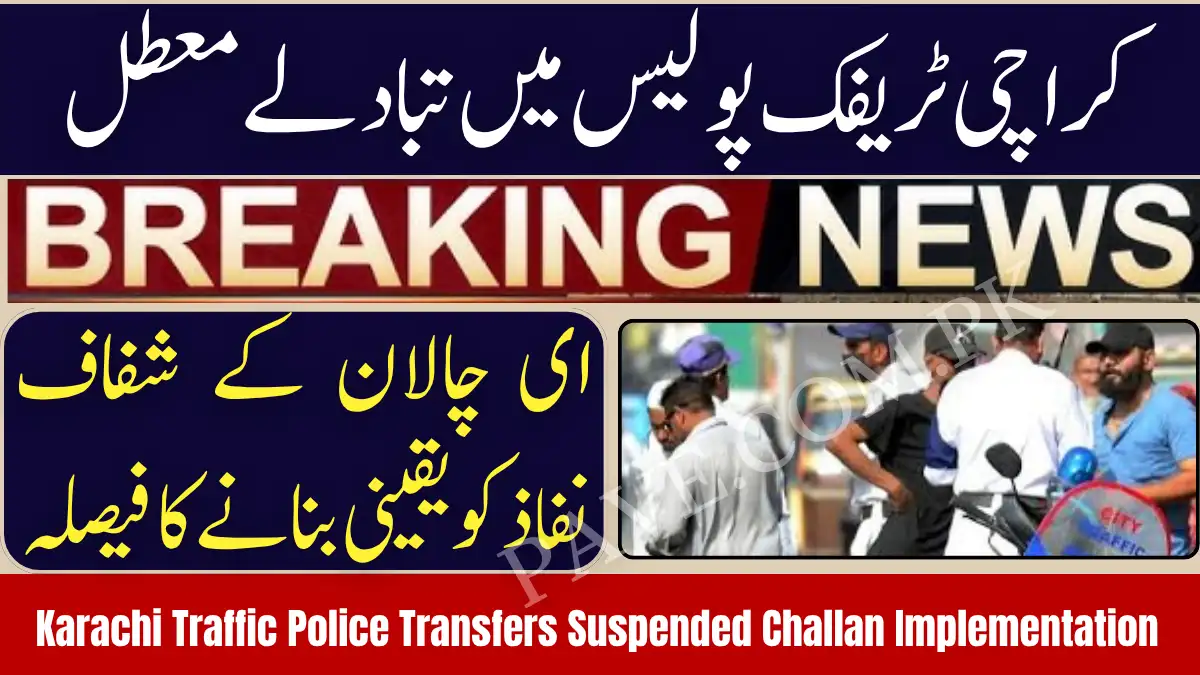
The Karachi Traffic Police transfers have been officially suspended by Inspector General Sindh Police Ghulam Nabi Memon, in a bold administrative move aimed at ensuring the smooth and corruption-free implementation of the newly expanded e-challan system Karachi.
The directive — issued late Sunday — immediately halts all ongoing and pending transfer orders within the city’s traffic division. The decision comes amid growing emphasis on digital transparency, performance accountability, and long-term stability within the traffic police department of Pakistan’s largest metropolis.
IG Sindh’s Directive: Stability for Accountability
A Turning Point for Karachi’s Traffic Department
According to official sources, IG Ghulam Nabi Memon has linked officer stability directly to the performance and integrity of the digital traffic enforcement system. His order states:
- No traffic officer or constable can be transferred to any district police posting.
- All pending or pre-approved transfer orders stand canceled immediately.
- Officers must continue serving in their current jurisdictions to ensure uninterrupted e-challan monitoring and performance tracking.
This unprecedented step marks the first time in years that Sindh Police has prioritized continuity over political or administrative reshuffles. Officials say this reform is intended to create long-term accountability and performance-based evaluation within Karachi’s traffic management structure.

E-Challan System Karachi: A Foundation for Smart Policing
The E-challan system Karachi is the centerpiece of Sindh’s new traffic management policy Pakistan, using AI-driven cameras to monitor violations across major intersections. The technology automatically detects offenses such as overspeeding, signal jumping, lane violations, and helmet or seatbelt non-compliance.
Once a violation is recorded, a digital challan is generated and linked to the vehicle owner’s CNIC and registration details through NADRA’s centralized database. The fine can then be paid online — a major departure from Pakistan’s traditional manual ticketing system.
Why Stability Matters for Digital Reform
Under the old system, frequent transfers of officers made it difficult to maintain consistency and data tracking. The Karachi Traffic Police transfers ban ensures that trained personnel remain stationed long enough to fully understand the digital operations, analytics dashboards, and surveillance integration models required for efficient monitoring.
In short, it’s a policy that favors continuity, expertise, and transparency — the very pillars that digital governance thrives on.

Ending Corruption and Improving Efficiency
Reforming the Culture of Frequent Transfers
Historically, internal reshuffling within Karachi’s traffic police has been associated with favoritism, inefficiency, and sometimes, direct influence by external elements. Officers often sought transfers to avoid accountability or to secure lenient postings.
By freezing all Karachi Traffic Police transfers, the department aims to remove this administrative loophole. Senior officials told CM News that the ban will prevent officers from escaping performance audits or avoiding e-challan scrutiny by switching districts.
“When officers stay in one post long enough, you can measure real performance. The e-challan system provides data that can’t be manipulated — and stability is the key to making it work,”
— said a senior traffic official familiar with the policy.
Performance Through Data
Under the digital traffic enforcement model, every violation captured by smart cameras is logged, along with officer activity reports. This allows the DIG Traffic office to analyze which zones are effectively enforcing the law and where intervention is needed.
Also Check: Breaking News: Pakistan and Saudi Arabia Sign Hajj 2026 Agreement

Why Some Officers Wanted Transfers After E-Challan Launch
After the e-challan system was expanded citywide, several officers reportedly submitted transfer requests. According to insiders, certain personnel who were uncomfortable with the transparency of digital monitoring sought to move back to traditional departments where manual ticketing still allowed discretion.
DIG Traffic immediately raised this issue with higher authorities, prompting IG Ghulam Nabi Memon to impose a complete transfer freeze.
The IG’s stance is clear: officers unwilling to adapt to the e-challan system will be retrained — not relocated.

Long-Term Goals: Data-Driven Karachi Road Safety
Modern Policing, Safer Roads
Beyond administrative reform, the transfer ban is part of a long-term Karachi road safety strategy. The government aims to reduce accidents, improve driver discipline, and increase compliance with traffic laws through real-time monitoring.
By retaining the same officers in each district, officials expect improved coordination, quicker violation response, and fairer enforcement of laws.
| Objective | Expected Outcome |
|---|---|
| Consistent enforcement | Equal application of rules across all areas |
| Reduced corruption | Elimination of manual challan manipulation |
| Improved driver discipline | Data-backed monitoring through cameras |
| Efficient fine recovery | Automated payment and tracking system |
| Transparent governance | Public access to challan verification online |
The police accountability reform ensures that performance evaluations will now rely on measurable outcomes, such as the number of violations captured, fine recovery rates, and reduction in road accidents per zone.
Public Reaction: Cautious Optimism
Citizens have largely welcomed the ban on Karachi Traffic Police transfers, viewing it as a long-awaited step toward professionalizing the force.
Karachi-based journalist Ali Raza commented,
“For the first time, traffic enforcement in Karachi is being treated as a structured profession rather than a posting. The e-challan system and this stability-focused policy could finally change public perception about fairness in law enforcement.”
Motorists are also optimistic that the uniform implementation of rules will minimize street-level disputes and improve trust between officers and citizens.
A Model for Other Cities
The Sindh Police leadership has hinted that if successful, this traffic management policy Pakistan model could be expanded to other cities, including Hyderabad and Sukkur.
Experts believe that Karachi’s digital traffic transformation could serve as a case study for other provinces struggling with similar challenges of corruption, mismanagement, and public mistrust.
Urban policy analyst Dr. Mehak Alam said,
“The Sindh Police is moving in the right direction by blending technology with accountability. If Karachi succeeds, it will set a national precedent for data-led policing in Pakistan.”
Impact on Karachi Drivers
The e-challan expansion coupled with the transfer freeze will significantly impact daily commuters. Drivers will now experience:
- Uniform enforcement: Traffic rules will be applied consistently across all districts.
- Data-backed penalties: Every challan will include photographic or video proof.
- Reduced harassment: No officer can issue or waive off challans manually.
- Faster dispute resolution: Digital records will allow quick complaint handling.
- Enhanced safety: Fewer reckless drivers due to automated monitoring.
By removing the uncertainty that comes with changing officers and inconsistent enforcement, Karachi’s commuters are expected to benefit from more predictable, fair, and transparent policing.
Also Check: Car Owners Alert: Punjab Reveals New Emission Testing Fee 2025
Administrative Reform Beyond Policing
The ban on Karachi Traffic Police transfers reflects a broader administrative philosophy within Sindh Police — that stability and accountability go hand in hand. Officials hope that this policy, combined with technology-driven enforcement, will not only reduce corruption but also improve institutional discipline across departments.
Financial analysts also highlight that the e-challan system’s increased efficiency could help recover significant municipal revenue lost through manual leakages, allowing the government to reinvest in infrastructure and road safety campaigns.
Conclusion
The suspension of Karachi Traffic Police transfers marks a watershed moment in the city’s journey toward digital governance and transparent law enforcement. With IG Sindh Ghulam Nabi Memon leading this reform, the goal is clear — strengthen the e-challan system Karachi, hold officers accountable through measurable data, and make Karachi’s roads safer and more disciplined.
If implemented effectively, this digital traffic enforcement model could become a benchmark for modern policing in Pakistan. Stability in leadership, consistency in enforcement, and citizen cooperation will ultimately determine the long-term success of this landmark initiative.
As Karachi embraces smart policing, the city’s chaotic roads might finally see the order and safety its citizens have long demanded.