
E-Bike vs Petrol Bike: Cost Comparison for Students and Workers in 2025
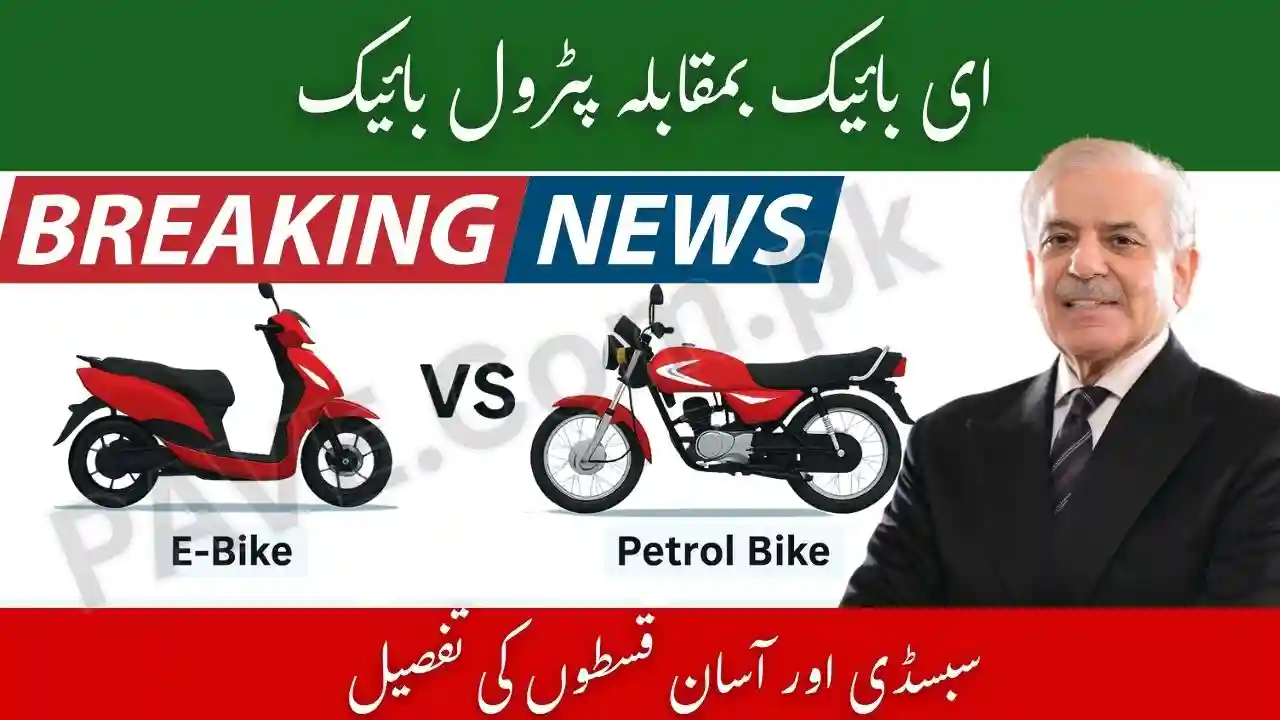
E-Bike vs Petrol Bike have become one of the most popular mobility options in Pakistan, especially among students, office workers, delivery riders, and daily commuters. With rising petrol prices, high maintenance costs, and increasing interest in eco-friendly transport, many people now compare E-bikes vs Petrol bikes to understand which option is more affordable and practical in 2025.
This comprehensive cost comparison explains fuel expenses, maintenance costs, battery life, resale value, commute savings, government subsidies (PAVE Program), durability, performance, and overall long-term value. It also helps students and low-income workers decide which option is better according to their monthly budget.
Why Students and Workers Are Shifting to Electric Bikes in 2025:
In 2025, mobility trends in Punjab and across Pakistan are changing rapidly. The Punjab Government’s PAVE Program has introduced subsidized E-bike financing, interest-free installment plans, and easy monthly payments—making electric bikes more accessible for everyone.
For students living in hostels, office workers traveling 20–40 km daily, and delivery riders covering long distances, the cost difference between petrol and electric mobility has become more significant than ever.
This article highlights the real-world cost comparison of E-bike vs Petrol bike, allowing you to calculate how much you can save every month and year.
E-Bike vs Petrol Bike Cost Comparison 2025 – Complete Breakdown

1. Purchase Price (Initial Cost) – Which One Is Cheaper?
E-Bike Price 2025
Depending on the brand and battery capacity:
- Basic E-Bike: Rs. 180,000 – Rs. 200,000
- Mid-Range E-Bike: Rs. 220,000 – Rs. 260,000
- Premium E-Bike: Rs. 280,000 – Rs. 330,000
Petrol Bike Price 2025
- 70cc Petrol Bike: Rs. 140,000 – Rs. 170,000
- 100cc Petrol Bike: Rs. 180,000 – Rs. 220,000
- 125cc Petrol Bike: Rs. 240,000 – Rs. 330,000
- 150cc Premium Bikes: Rs. 350,000+
Verdict
Petrol bikes are cheaper at the time of purchase. However, when considering fuel cost for one year, E-bikes become much more affordable overall.

2. Fuel Cost vs Charging Cost – The Biggest Savings for E-Bike Users
Petrol Bike Fuel Cost (Monthly)
Petrol Price (2025 Approx): Rs. 280–300 per liter
Average mileage:
- 70cc bike: 60–70 km/l
- 125cc bike: 45–50 km/l
For daily 30 km travel (900 km/month):
- Fuel needed: 15–20 liters
- Monthly fuel expense: Rs. 4,500 – Rs. 6,000
For delivery riders traveling 50–80 km/day:
- Monthly fuel: Rs. 8,000 – Rs. 12,000
E-Bike Charging Cost (Monthly)
E-Bike consumes approx. 1.5–2 units per full charge.
Cost per unit (with taxes): Rs. 55–65
Daily charge cost: Rs. 80–100
Monthly charging cost:
- Rs. 2,000 – Rs. 3,000 (regular commuters)
- Rs. 3,500 – Rs. 4,000 (delivery riders)
Verdict
E-bike charging cost is 50% to 70% cheaper than petrol bike fuel cost.

3. Maintenance Cost Comparison – Which One Is Costlier?
Petrol Bike Maintenance
Petrol bikes need:
- Oil changes every 1,000 km
- Tuning every 3–4 months
- Filter replacement
- Clutch, chain, plug adjustments
- Engine repair after 2–3 years
Average yearly maintenance cost:
Rs. 12,000 – Rs. 18,000
E-Bike Maintenance
E-bikes have:
- No engine
- No oil changes
- No spark plugs
- No exhaust
- No carburetor issues
Maintenance includes:
- Brake pad adjustment
- Tyre check
- Chain lubrication
- Occasional wiring check
Average yearly cost:
Rs. 4,000 – Rs. 7,000
Verdict
E-bikes are 60% cheaper to maintain.

4. Battery Life vs Engine Life – Long-Term Reliability
E-Bike Battery
Battery lifespan:
- Lithium battery: 3–4 years
- Replacement cost: Rs. 35,000 – Rs. 65,000
Petrol Bike Engine
Engine life:
- 6–8 years
- Major overhaul cost: Rs. 20,000 – Rs. 40,000
Verdict
Battery replacement can be expensive, but overall running cost of E-bike still remains lower than petrol bikes.
5. Daily Commute Cost – Who Saves More in 2025?
For Students
Average travel: 20–30 km/day
Monthly saving with E-bike: Rs. 3,000 – Rs. 4,000
For Office Employees
Monthly saving: Rs. 4,000 – Rs. 6,000
For Delivery Riders
Daily travel: 60–100 km
Monthly saving: Rs. 6,000 – Rs. 10,000
Verdict
Students and workers can recover extra E-Bike cost within 8–12 months through fuel savings.
6. Resale Value Comparison
Petrol Bike Resale
- High resale market
- Depreciation: 10–15% yearly
E-Bike Resale
- Growing resale market
- Depreciation: 15–20% yearly
Verdict
Petrol bikes still have better resale value, but E-bike resale demand is increasing in Punjab.
7. Environmental and Health Benefits – Why E-Bikes Are Better for Cities:
Electric bikes offer:
- Zero emissions
- No smoke
- No noise
- Cleaner air in cities
With increasing smog in Lahore and Punjab, E-bikes provide a healthier and safer alternative.
8. Government Subsidies and Installment Plans (PAVE Program 2025):
The Punjab Government offers:
- Zero-interest E-bike financing
- Up to 30–50% subsidy
- Easy monthly installments (Rs. 5,000 – Rs. 7,000)
- Digital verification system
- Distribution through authorized dealers
This makes E-bikes far more affordable than petrol bikes.
9. Performance Comparison – Speed, Power, and Range:
E-Bike Performance
- Speed: 50–70 km/h
- Range: 60–90 km per charge
- Great for city rides
- Smooth and silent
Petrol Bike Performance
- Speed: 80–100 km/h
- Long-distance rides
- Better pickup and hill performance
Verdict
Petrol bikes perform better on highways.
E-bikes are ideal for city commuting.
Full Cost Summary Table – E-Bike vs Petrol Bike 2025:
| Category | E-Bike (2025) | Petrol Bike (2025) |
|---|---|---|
| Initial Price | Higher | Lower |
| Fuel/Charging Cost | Rs. 2,000–4,000 | Rs. 5,000–12,000 |
| Maintenance | Low (Rs. 4,000–7,000/year) | High (Rs. 12,000–18,000/year) |
| Battery/Engine | Battery replacement after 3–4 years | Engine overhaul after 6–8 years |
| Performance | Best for city | Best for long routes |
| Resale Value | Medium | High |
| Eco-Friendly | Yes | No |
| Government Subsidy | Yes (PAVE) | No |
Conclusion: Which Bike Is Better for Students & Workers in 2025?
If your goal is monthly savings, low maintenance, and affordable commuting, then:
E-Bike is the best option in 2025.
If you need long-distance performance, strong pickup, and highway travel, then:
A petrol bike is better for you.
However, with the PAVE Government Subsidy, E-bikes have become the most cost-effective mobility solution for students, jobholders, low-income workers, and delivery riders.
Read More: Local Manufacturing & PAVE: How Pakistan Plans to Build Its Own Electric Vehicles
Top FAQs – E-Bike vs Petrol Bike Cost Comparison 2025:
Q1: Are E-bikes cheaper to maintain than petrol bikes?
Yes, E-bikes require no engine oil, tuning, or major repairs. Maintenance cost is almost 60% lower.
Q2: How much can I save monthly by using an E-bike?
You can save Rs. 3,000 to Rs. 10,000 per month, depending on daily travel.
Q3: How long does an E-bike battery last?
A lithium battery lasts 3 to 4 years and costs Rs. 35,000–65,000 to replace.
Q4: Which bike is better for delivery riders?
E-bikes are cheaper per km, but for 100+ km daily riders, petrol bikes offer better backup.
Q5: Does the government give subsidy on E-bikes?
Yes, under the PAVE Program, students and workers get zero-interest financing and installment plans.