ECC Approves Payment Settlement With OGDC, SNGPL, and Nuclear Power Plants – Major Power Sector Reforms Announced 2025
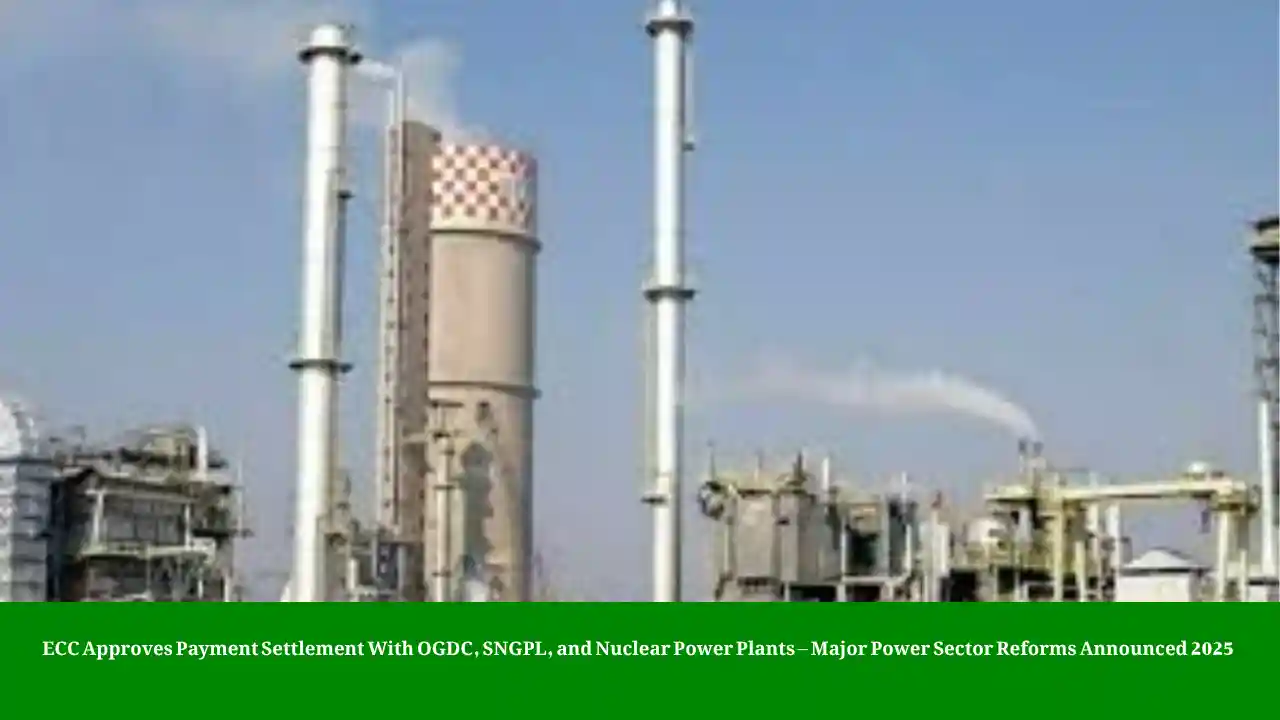
The Economic Coordination Committee (ECC) of Pakistan has approved a comprehensive financial framework aimed at resolving long-standing payment disputes between key state-owned energy entities and power generation companies. The move is a major step toward tariff rationalization and fiscal stabilization within Pakistan’s energy sector — one of the country’s most financially burdened domains.
This decision, approved during a meeting chaired by the Finance Minister, includes payment settlements with Oil and Gas Development Company Limited (OGDCL), Sui Northern Gas Pipelines Limited (SNGPL), and nuclear power plants, among other stakeholders.
ECC Approves Key Power Sector Reforms 2025
The ECC endorsed a detailed payment settlement framework proposed by the Power Division. Under this plan, overdue payments owed by government-owned power generation companies to OGDCL, SNGPL, and nuclear power producers will be cleared through mutual adjustments and financial restructuring.
Officials said the reforms are designed to reduce the circular debt, which currently exceeds Rs. 2.6 trillion, and to bring greater financial discipline to the sector. The decision also includes the waiver of select financial claims among state entities to ensure a smooth transition toward tariff rationalization and long-term fiscal balance.
Power Division’s Proposal – Settling Long-Pending Dues
The Power Division presented a summary to the ECC highlighting the severe liquidity challenges faced by energy producers due to delayed payments. The division proposed the following measures:
- Clearing outstanding payments owed to OGDC, SNGPL, and nuclear power plants.
- Waiving interest-based claims between inter-governmental organizations to simplify settlements.
- Introducing a transparent reconciliation system for real-time tracking of payments.
- Gradually reducing capacity payment liabilities under Power Purchase Agreements (PPAs).
The committee approved these proposals after consultations with the Finance Division and the Ministry of Petroleum, emphasizing that this would reduce financial strain on power generation companies and improve cash flows across the energy supply chain.

Rationalizing Tariffs and Improving Fiscal Balance
One of the core objectives of the ECC’s decision is tariff rationalization — ensuring that energy tariffs reflect real costs while remaining affordable for consumers. The framework encourages a balanced cost-sharing approach among government institutions, energy producers, and consumers.
Officials noted that these measures would stabilize the national power tariff in the upcoming fiscal year and help avoid sudden hikes driven by circular debt accumulation.
ECC Defers PIBT Port Qasim Proposal
During the same meeting, the ECC also discussed a proposal by the Ministry of Maritime Affairs regarding the use of the Pakistan International Bulk Terminal (PIBT) at Port Qasim for the export of minerals, metals, and copper-gold commodities.
However, the Committee deferred approval, directing the Ministry to consult all relevant stakeholders, including the Commerce Division and Federal Board of Revenue (FBR), before resubmitting a refined proposal. The ECC emphasized that a clear policy and revenue-sharing mechanism must be developed before any final decision.

ECC Approves Technical Supplementary Grant for Pak PWD Staff
In another major development, the ECC approved a Technical Supplementary Grant (TSG) of Rs. 960.27 million to pay salaries of employees transferred from the Pakistan Public Works Department (Pak PWD) to the Capital Development Authority (CDA) for the current quarter.
The Finance Minister directed the CDA to submit a comprehensive plan by December 2025 outlining the staff’s placement strategy and future funding mechanisms from October 2025 to June 2026.
This move is part of broader efforts to streamline federal-to-municipal workforce transfers and avoid delays in staff compensation.
Gas Allocation for Fertilizer Plants – Boosting Agriculture
The ECC also approved a summary from the Petroleum Division to ensure a steady gas supply from Mari Field to major fertilizer plants at a regulated pricing structure.
The decision aims to support farmers and the agriculture sector by stabilizing fertilizer prices and ensuring consistent availability of urea and DAP fertilizers ahead of the Rabi cropping season.
The ECC reaffirmed that fertilizer affordability remains a top government priority as Pakistan continues to focus on agriculture-led economic recovery.
Raed Also: Punjab Approves Establishment of Air Punjab Private Limited Company – Key Cabinet Decisions 2025
Comprehensive Approach to Fiscal and Energy Reforms
The ECC’s latest decisions are being viewed as part of a broader fiscal reform strategy under Pakistan’s ongoing engagement with the International Monetary Fund (IMF). The goal is to improve debt management, reduce fiscal deficits, and restore investor confidence.
Analysts believe that resolving intra-government payment bottlenecks is a crucial step toward improving the country’s credit outlook and ensuring reliable energy supply for industries.
Circular Debt – The Core of the Problem
Pakistan’s power sector has long suffered from circular debt, which arises when distribution companies fail to recover full payments from consumers, leading to cascading arrears through the energy chain.
| Stage | Entity | Problem |
|---|---|---|
| 1 | Consumers | Delayed or partial payments of electricity bills |
| 2 | Distribution Companies (DISCOs) | Insufficient revenue to pay power producers |
| 3 | Power Producers (GENCOs/IPPs) | Payment delays to fuel suppliers like OGDCL and SNGPL |
| 4 | Fuel Suppliers | Liquidity constraints and delayed production |
By clearing outstanding liabilities and rationalizing tariff adjustments, the ECC’s payment settlement mechanism is expected to break this cycle and stabilize the sector.
ECC Meeting Highlights
The ECC meeting, chaired by the Federal Minister for Finance, was attended by:
- Federal Minister for Power
- Federal Minister for Petroleum
- Minister for National Food Security
- Minister for Commerce
- Senior officials from OGDCL, SNGPL, NEPRA, and Finance Division
Each ministry presented progress updates on financial settlements, infrastructure projects, and reforms under their jurisdiction.
ECC’s Role in Strengthening Pakistan’s Economy
The Economic Coordination Committee remains one of Pakistan’s most powerful economic decision-making forums. Over the years, it has played a vital role in approving emergency financial measures, resolving energy sector disputes, and guiding macroeconomic stabilization policies.
By approving the latest power sector payment framework, the ECC has set the stage for a more transparent and accountable financial ecosystem that aligns with international fiscal discipline standards.
Raed Also: Punjab Announces School Teaching Interns STIs Jobs 2025 – Monthly Salary Up to Rs.45,000
Potential Impact on Power Tariffs and Consumers
Energy experts say the ECC’s decisions will likely prevent future tariff shocks by reducing the backlog of unpaid dues. However, gradual tariff adjustments may still occur in the coming months as part of the government’s IMF commitments.
If properly implemented, the reforms could reduce power losses, encourage investment in clean energy, and restore public confidence in Pakistan’s energy institutions.
Analyst Opinions on ECC’s Approval
Economist Dr. Salman Shah said the ECC’s plan is a “constructive move toward structural energy reform,” but emphasized that long-term sustainability would depend on implementing governance reforms in distribution companies.
He added that clearing government-to-government dues is only the first step; the real challenge is ensuring revenue-based accountability and preventing debt from re-accumulating.
Future Steps – Energy and Fiscal Roadmap 2026
Following this approval, the Power Division and Finance Ministry are expected to jointly implement a Payment Settlement and Monitoring System (PSMS) by March 2026.
This digital system will track all inter-agency payments, automate billing reconciliations, and help NEPRA assess the impact on national tariffs in real time.
Officials confirmed that a comprehensive Energy Sector Policy Framework 2026–2030 will be announced in early 2026 to sustain these reforms.
Trending FAQs About ECC Payment Settlement 2025
1. What did the ECC approve in November 2025?
The ECC approved a comprehensive framework to settle dues among OGDCL, SNGPL, and nuclear power plants, rationalize tariffs, and reduce circular debt.
2. How will this affect Pakistan’s power sector?
The settlement will improve liquidity, help energy companies pay suppliers on time, and stabilize the power tariff system for consumers.
3. What is the purpose of the Technical Supplementary Grant (TSG)?
The ECC approved Rs. 960 million for paying salaries of transferred Pak PWD staff under the CDA for the current fiscal quarter.
Gas from Mari Field will be allocated to fertilizer plants at affordable rates to ensure fertilizer availability for the agriculture sector.
Gas from Mari Field will be allocated to fertilizer plants at affordable rates to ensure fertilizer availability for the agriculture sector.
5. What is the ECC’s long-term goal with these reforms?
The ECC aims to achieve fiscal balance, tariff stability, and energy sector transparency while reducing Pakistan’s dependence on foreign borrowing.